How Nonprofits Can Manage AI-Driven Change in Web Design
AI is reshaping every phase of a nonprofit website build — discovery, design, code, and how donors find you. Here's what actually changed, what to leave alone, and how to stay the human in the middle.

Categories
Publish Date
Services
Share


Don't let AI "just make you a site."
That's the fast track to a website that looks great and raises nothing. We bring the human strategy that makes it convert.
TL;DR
- AI hasn't replaced nonprofit web designers — it's compressed the work so a four-person team can outproduce a twenty-person one, with better strategy, better data, and a higher bar than before.
- The deliverables are 75–80% the same; what changed is the speed, the depth, and the size of the team needed to produce them.
- Managing AI-driven change is now a leadership decision, not a technical one — the gains come from putting a human at every checkpoint to guide the tools, not from handing the work over to them.
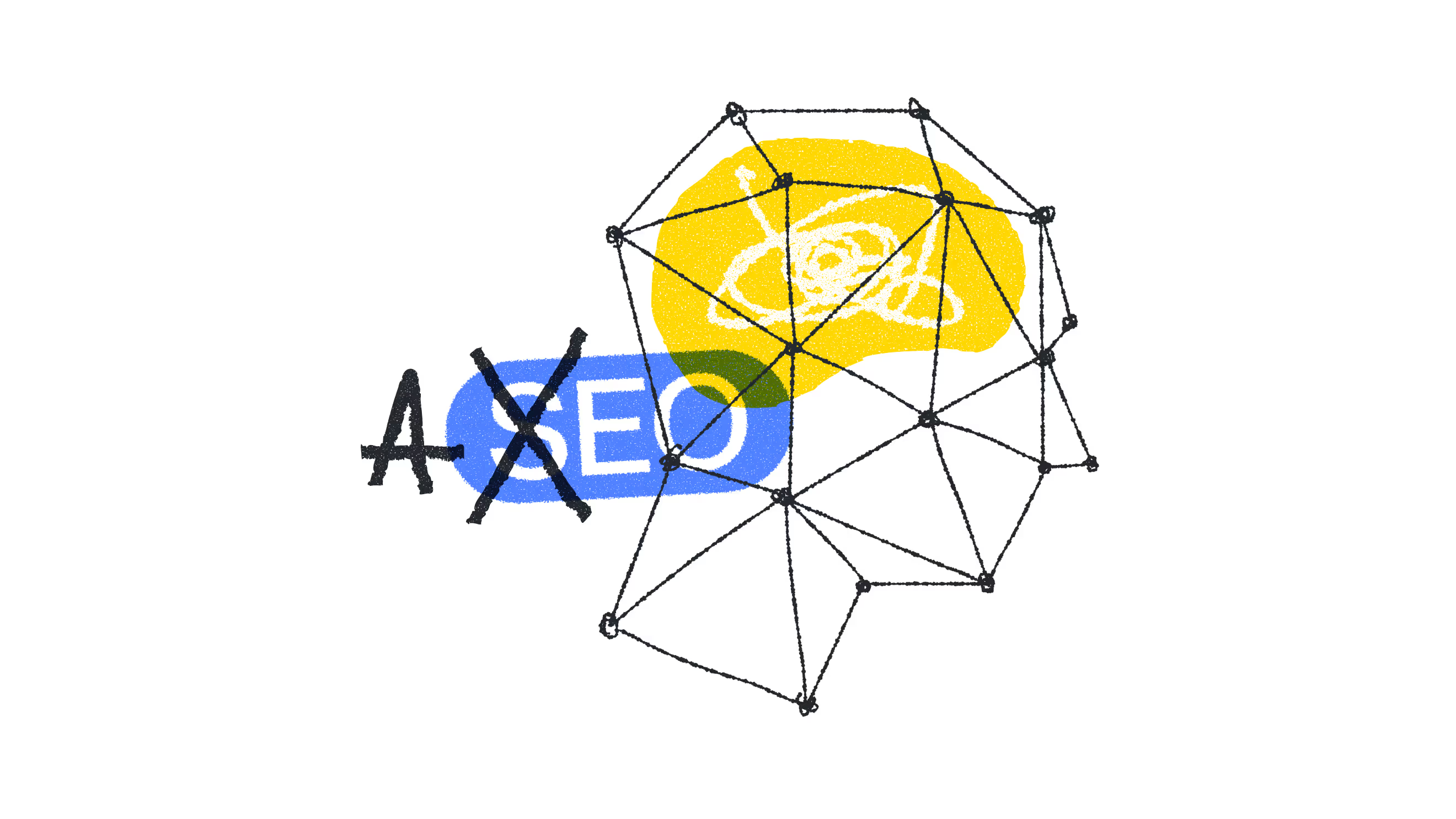
- The larger shift is that your website now has to be readable by AI agents, not only people, which moves discoverability from SEO to answer-engine optimization (AEO).
- The nonprofits pulling ahead treat AI as a catapult — Fortune-100 tools on a nonprofit budget — and manage the change deliberately instead of fearing it or chasing every shiny tool.
AI Changed Everything About Nonprofit Web Design. And Almost Nothing.
Ask anyone in the agency world whether AI changed web design and they'll tell you everything's different. They're right. They're also missing the more useful half of the answer.
When I sit down to build a nonprofit website today, 75 to 80 percent of the work looks like it did three years ago. Same strategic audits and audit documentation. Same project briefs, site maps, wireframes, design comps, design systems, QA tickets, project management. The deliverables didn't change.
What changed is who makes them. The twenty-person team became a three-to-four-person team running a lot of agentic work — prompts, scripts, documented processes — backed by far better data. And the small team outperforms the big one. Better code, better design, better strategy, sharper insights, in a fraction of the time. The way I put it to my own people: each person on the team can now be a superhuman.
So no — AI didn't replace the nonprofit web designer. It changed what one designer can do, and it quietly added a second audience to every site we build: machines. Both of those shifts matter for your next website. Here's what's actually different, what hasn't moved, and what it means for the site you'll build in 2026.
How AI changed the work, phase by phase
The clearest way to see what's different is to walk a real project — discovery, design, build — and name what AI touched and what it left alone.
Discovery: same conversations, ten times the depth
The front of a project is still human. We still run the meetings, the workshops, the onboarding, the long intake conversations where a nonprofit tells us who it is. AI doesn't get to skip that, and it shouldn't.
What changed is what happens next. We take everything those conversations surface and run it against a documented database of our own frameworks and processes — and against everything the internet knows about you. Semantic lookups, third-party documentation, external signals. We're reading for donor resonance, checking whether the strategic layers stack up from business strategy down to channel and social strategy, and building a foundation before anyone touches a layout. It's the same synthesis we always did as humans, except now we can go ten times deeper and ten times wider than we ever could. That's the difference between a discovery phase that produces a tidy summary and one that produces a real strategic foundation for a nonprofit website.
Design: the freedom to throw away the other 90%
Exploration used to be slow. Mood boards and style tiles took the design team the better part of a week to assemble. Now we move through inspiration fast — this, not that, closer, closer — until we land on style tiles that actually capture where the brand should go, in a fraction of the time. With direct connections into Figma, we pull color palettes and brand content straight in.
The bigger change is iteration. Instead of designing one version of a testimonial block or a header and defending it, we can generate four or five and see what wins. One of the hardest parts of being a designer is throwing away 90 percent of what you make to keep the best 10 percent. On a small nonprofit budget, that kind of exploration used to be a luxury nobody could afford. Now it's standard. We can stretch design tools far enough to get to the right answer, not just a defensible one.
It reaches into assets, too. Two or three years ago a client had to hand us every photo, every video, every piece of B-roll. Now, give us five or six strong shots and we can extend them — turn photos into motion, build out a library that's true to life and true to cause, showing real people and real stories rather than stock. A professional extension of what a nonprofit already has, instead of a hard stop at what it could afford to shoot.
Build: where AI almost took over
Development is the first place I watched AI nearly take the wheel. Code from scratch, code straight out of Figma, automations running on the developer's own machine, tools that will stand up most of a site if you've handed them the right strategy and prompts.
Then there's quality. AI writes its own schema markup, pressure-tests the build, flags vulnerabilities — and at its best it does the audit, the QA, the recommended fixes, and pushes the deploys, while a developer stands to the side monitoring rather than hand-writing every line. The role shifted from writing code to guiding the thing that writes it. For a nonprofit, that matters more than it does for a corporate client, because most nonprofits could never staff a dedicated QA person. The accessibility check, the contrast audit, the vulnerability scan — that's a hire most missions never had the budget to make. Now it runs by default. (It's the center of how we think about technology and AI in nonprofit builds.)
Case study: an AI-first rebuild. The biggest overhaul I've lived through is Donately — the nonprofit fundraising platform I co-founded, which shares a founder and a family with Fifty and Fifty. (Disclosure: Donately and Fifty and Fifty are sister companies.) We took multiple code bases and rebuilt them with AI agents handling UX and design components from the ground up, with accessibility and visual contrast baked in. The result is an AI-first stack where a client bug can travel all the way to a fix in production without a person hand-touching the code. AI now triages support requests, spots issues on live campaign pages, and stands up new campaign pages from a concept. Smaller team, higher capability, a clean code base shipping daily and weekly deploys — a pace that's genuinely hard to hit with a large, human-only development team.
What hasn't changed (and probably won't)
Look back at that walk-through, and the pattern is hard to miss. AI got faster at the parts that were always mechanical. It got no better at the parts that were always the actual work.
It doesn't decide what belongs on your homepage. It doesn't hear the objection a major donor hasn't said out loud yet. It doesn't know when a microsite is the right move and when it's a distraction, and it doesn't carry the trust between a nonprofit and the people building its site.
That's the 75–80 percent that stayed the same. The frameworks, the strategic sequencing, the human standing in the middle deciding what's good enough to keep. AI made the team smaller and the output stronger. It didn't make the thinking optional. I know that is rapidly changing and this might very well be outdated by the end of the year, but it's where we are today!
The biggest mistake nonprofits make with AI
Here's the line that gets people in trouble: "Just make me a site."
It's too easy now to lean back, give a tool almost nothing — here's what we do, build us a website — and watch it produce something that looks great, looks like it'll rank, looks like it'll work. So you launch it. And it's generic, because you never gave it the data, the input, or the strategic direction to make it anything else.
The fix isn't to use less AI. It's to be the human in the middle. There are checkpoints in every build where you have to be hypervigilant about what you're asking AI to do and what you're accepting back — and design, creative, asset and content production are the slipperiest of those slopes. The discipline is the same one good designers always had: iterate. Make five, six, seven versions. Keep the best. Throw the rest away. Either build that discipline in-house, or work with a strategic guide who runs those iterations the right way so the thing you launch actually converts.
What to ask a web agency about AI in 2026
Managing AI-driven change starts with hiring right — the agency you choose either absorbs that change for you or hides behind it. Three questions separate the two:
- "Do you use AI in production?" A no is a walk-away signal. An agency not using AI today is a copywriter still insisting on a typewriter — every modern team should be using these tools to do its best work.
- "How do you think about the ethics of it — and where exactly do you use it?" You want openness: how they use AI to audit, to build reports and analytics, and what they intend to use it for on your account. Honest, specific answers are the green light; vague reassurance is the warning sign.
- "Who's guiding the tools?" This is where the red flags live. An agency planning to write all your content with AI and no copywriter — or expecting AI to design with no real design team — is using AI to stretch past its own skill set. What you want is skilled people guiding the tools, backed by case studies with real metrics that prove the AI-assisted work actually performed.
What a great nonprofit website looks like in 2026
Step away from AI for a second, because the most important change to nonprofit websites lives under the hood.
A great site in 2024 was beautiful, with HTML and CSS and motion used well, a clear brand, a clear message, and a clear sense of where to send a visitor next. All of that is still true. None of it is the differentiator anymore. The shift is that your website now has to speak to two audiences: human beings and agents. It has to be findable and understandable by a new layer of digital tools that read LLM text files, parse schema markup, and weigh third-party validation. Half the technology on a site got easier in the last two years. The other half got more complicated.
A few things are already true — not predictions, just reality most nonprofit leaders haven't fully caught up to:
- Mobile isn't "responsive," it's primary. Sixty to seventy percent of your traffic is on a phone. "Our site is responsive" was the 2020 answer. The 2026 question is whether it's a genuinely great experience on mobile, because that's where most of your supporters actually are.
- Giving has outgrown the donate button. Donor-advised funds, Venmo, social-platform donations — the ways people give keep multiplying. Neglecting how fast donation and fintech tooling is evolving quietly leaves money on the table. Meet donors where they are and give them ample ways to give.
- Stop running random acts of marketing. Plenty of organizations know they "need to do digital" and then throw effort at disconnected tactics. Step back, build one connected plan, and move your brand clarity into tools — a website that turns interest into curiosity into giving into revenue — with the marketing engines (automation, email, social, text) keeping every plate spinning. Stop throwing gum at the wall and confusing effort for outcomes. That connected system is exactly what an Engagement OS approach is built to produce.
One caution on all of this. The word "trend" carries risk. Every new shiny tool catches a board's eye, becomes the CEO's new priority, and gets jammed into the stack without a reason — AI itself is often the culprit now, with leadership scrambling to stuff ChatGPT or Claude or Perplexity into systems without knowing why. There's a difference between cutting edge and bleeding edge, and nonprofits should live at the cutting edge. The wins come from the grind — consistent, measurable effort — not the silver bullet. Put 80 percent of your budget on what you know works and can measure, and 20 percent on calculated risks that might become your next real channel.
Nonprofit websites: the old standard vs. the 2026 standard
Why your nonprofit is invisible to ChatGPT, Claude, and other AI tools
Getting cited by AI is now one of the clearest tests of whether a nonprofit is managing AI-driven change or being left behind by it. Most are invisible for one of two fixable reasons: their pages aren't machine-readable, or they haven't built credibility beyond their own website.
For years, SEO meant keywords, metadata, and content tuned for search engines. Answer engines and prompt-based search have taken over the top of the page — ask Google or Bing a question now and AI snippets sit above the traditional results. The question is no longer "do we rank?" but "do we show up in the answer?" Most organizations haven't invested in the linkbacks, citation strategies, entity consistency, and third-party validation that decide that, so they're missing from the snippet even when their old SEO was fine. The work now is a prompt strategy, not only a keyword strategy: content that answers the real questions people ask.
The fix splits into two parts.
Off-site — prove who you are where you don't control the page. Answer engines look for external validation, the credibility you can't manufacture on your own domain:
- A Wikipedia presence.
- Coverage on credible third-party reviews and sector sites.
- Real news coverage and PR — having a quiet comeback precisely because it's validation you don't own.
- Identical, unambiguous organization details across every platform (Google Business Profile, directories, sector listings), so the internet has one clear picture of who you are and doesn't confuse you with anyone else.
On-site — make every page legible to a machine. This is schema markup, page by page — small chunks of code far easier for a bot to read than scraping your HTML or screenshotting the page:
- FAQ schema.
- Article and author schema.
- Clean, semantic HTML structure underneath it all.
What makes nonprofit discoverability different
Most discoverability advice is written for businesses — "best CRM," "dentist near me." A lot of it transfers, and I spend real time telling nonprofits to act more like for-profits: you're selling a product, you have customer journeys, you have retention and churn, treat them that way.
The difference is the subject matter. A nonprofit's content is story-centric, so the prompts you can rank for are story-driven. Your job is to find the stories you can genuinely deliver on — ones that are persuasive to a donor and true to the mission. That's the hard part, and it's structurally different from a for-profit's: a business speaks to the person who receives the benefit. A nonprofit's story is all it's got, and it has to connect a benefit to someone else — the beneficiary — back to the person it's actually talking to, the donor. Understand what donors are really looking for when they ask an answer engine, and deliver the narrative that meets it. (We go deeper on this in our writing on donor resonance and nonprofit web strategy.)
What nonprofit leaders are sleeping on right now
Not a prediction — something already sitting on the table, unused, in most organizations: the insight you can pull from your own donor data.
These tools can read your analytics and your donor flows, find the flaws in your setup, and summarize patterns you couldn't have surfaced six months ago. The data is there. What's new is your ability to turn it into personalized, authentic donor experiences — automations, email series, newsletters tuned to who your supporters actually are. Put the right people at the table with these tools and AI stops being a content gadget and becomes one of the most useful voices in the room when you're building strategy, grounded in the data that decides whether you succeed.
So, the honest answer to the question this whole piece started with: AI isn't a threat to nonprofit web design. It's a catapult. The nonprofit world runs on small budgets, fast turnarounds, and the constant demand to do more with less — and it just got handed the same tools as the Fortune 100, at a fraction of the cost, usable by a fraction of the team. That's worth being honest about, smaller teams included. But for the sake of the cause, the move isn't to fear it. It's to use it — to make your people superhuman and multiply the impact of the mission you're already giving everything to.
If you're rethinking your next website with all of this in mind, we're happy to crompare notes.
FAQ
- How can nonprofits manage AI-driven change in web design? The organizations managing it well treat AI as a tool with a human in the middle, not an autopilot. That means putting a person at every checkpoint — strategy, design curation, content, QA — to decide what AI output to keep and what to reject, spending roughly 80% of budget on proven, measurable work and 20% on calculated bets, and living at the cutting edge rather than the bleeding edge. Managed this way, a four-person team can outproduce a twenty-person one without losing the judgment AI can't replace.
- Will AI replace nonprofit web designers? No. AI is replacing the slow, mechanical parts of the work and shrinking the team needed to do it — a four-person team can now outproduce a twenty-person one. The judgment work (strategy, what goes on the homepage, the donor objection you haven't heard yet, the trust with the client) is still human, and still the job.
- Should a nonprofit use an AI website builder or hire an agency? A builder gets you to something that looks finished fast — which is exactly the trap. "Just make me a site" with no strategic input produces a generic result that won't convert. AI pays off only with a human in the middle guiding it through real iteration; if you don't have that discipline in-house, that's what a good agency provides — and it's the core of managing AI-driven change instead of being managed by it.
- What are AEO and GEO, and why do they matter for nonprofits? Answer Engine Optimization and Generative Engine Optimization are about showing up inside AI-generated answers (ChatGPT, Claude, Google's AI snippets) rather than only in the blue links below them. AI snippets now sit above traditional search results, so a nonprofit invisible to answer engines is invisible to a fast-growing share of how people search.
- Why isn't my nonprofit showing up in ChatGPT or Claude answers? Usually one of two reasons: your pages lack the schema markup (FAQ, Article, author) that lets a bot read them cleanly, or your organization hasn't built enough credible validation off your own site — Wikipedia, news coverage, consistent third-party profiles — to be trusted as a citable source.
- How is AI actually used in a real nonprofit web project? Across every phase: synthesizing discovery research far deeper than before, generating and iterating design options instead of defending a single one, extending limited photo and video assets, writing and QA-testing code and schema in the build, and after launch, reading donor data to personalize the experience.
Have a project or idea?
We believe in the hard work people are doing to address the world's most pressing problems. Every day, our agency fights to turn visions of social change into concrete realities.
Nonprofit CMS Guide: How to Choose the Right One
How to Build a Microsite for Your Nonprofit: Six Use Cases From Real Campaigns
What Makes a Good Nonprofit Website? 10 Elements, Proven by Real Builds
.jpg)
Best Nonprofit Website Examples to Drive Conversions & Inspire Your Brand
